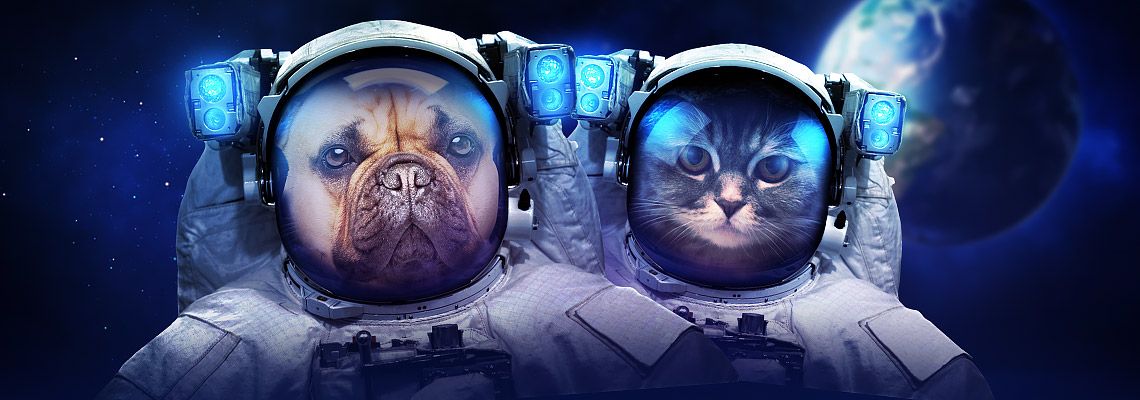
Space Woof – Sending Dogs (and Cats) Into Space
 7 min
7 min
Our obsession with space goes back decades It’s been widespread and persistent since we looked up and thought ‘that’s an awful lot of space’. As a species, we’re hell-bent on exploring the unknown, discovering new worlds, pushing the boundaries of our limits, and then pushing them further sometimes rather painfully and embarrassingly. Curiosity and exploration are vital to the human spirit and accepting the challenge of firing dogs into space seemed the logical thing to do at the time.
The Space Race
Just to straighten things out, dogs weren’t the first. The first animals propelled into orbit were primates and mice, sent up by the Americans in 1948 to investigate the influence of weightlessness on mammals. The late 1960s also saw the integration of animals being sent to space purely for scientific nosiness and less to gauge the human survival likelihood. Space bound flights took cats, rabbits, turtles, fish, insects and frogs into space throughout this period. Mechanical hiccups doomed most of them. Most animals sent up for tests, particularly in the beginning of the space race, met gruesome ends, either by an explosion, hypothermia, starvation, or intentional poisoning. Those who lived were VIPs and bestowed with majestic lives until their final days, but their ranks are thin and the price they paid is hard to measure.
Cats
In 1963, the French entered the race with a black-and-white cat named Félicette. Ooh la la! Actually, they were all set to send a male cat named Felix, but the little rascal got cold paws and ran away before the mission. Scientists from the French space agency found a stray cat called Félicette roaming the streets of Paris, and transformed her from an alley cat into the first and only cat to travel to space.
On October 18, 1963, Félicette was blasted into the sky for a non-orbital flight that lasted about 15 minutes. After reaching a height of 156 kilometres the capsule parachuted back down to Earth and our kitty star was safely recovered and rewarded with copious amounts of kitty biscuits. Purrr-fect. France never followed up their kitty cat space flight with a manned mission. And so, Félicette’s journey was relegated to the litter box of history.
Dogs
Dezik and Tsygan were the first dogs to be strapped into a rocket on July 22, 1951. The scientists were tickled pink at their safe return. Even the head honcho of the space program Sergey Korolev, had a moment of euphoria — grabbing one of the dogs and running around like a nutcase. A week later Dezik would snuff it alongside another dog called Lisa when their capsule’s parachute didn’t quite function like a proper parachute should. The exact number of flights is still a mystery, but it is likely that between July 1951 and November 1960 more than 30 suborbital flights left the launch pad. At least 15 of the dogs involved in these flights met their doom.
The Russians favoured using small stray dogs because they believed they’d be more obedient than monkeys. Strays were assumed to be much tougher than homely dogs, as they had to fight their own battles on the city’s streets. A few of these mutts actually made it safely back to terra firma. Probably the most legendary was Laika, a stray pooch and the first living being to orbit the earth in Sputnik 2. Tragically, Laika died November 3rd, 1957 of overheating and stress a few hours into her journey. Sadly, this was a one-way ticket for her, as it was never intended to bring her home because the spacecraft had no re-entry plan. Over five months later, after 2,570 orbits, Sputnik 2 – including Laika’s lifeless body – broke up and disintegrated during re-entry on April 14, 1958.
Laika isn’t the only canine cosmonaut that perished at the hands of the Soviet space program. In fact, over a dozen other dogs lost their lives well before her time. However, it wasn’t all bad news. Some Soviet space dogs lived and went on to live normal doggy lives. Belka and Strelka touched down safely, and became overnight pop stars. Laika, Belka, Strelka, and other publicized dogmonauts epitomized absolute Soviet heroism. They were valued as humble creatures sacrificing their lives for their country and the progression of space exploration. They were believed to possess such human qualities as courage and dedication and therefore deserved to be featured on stamps, postal covers, toys, children’s books, cigarette packages, and candy tins featured these furry icons. Good old Laika has bands named after her, monuments erected to her, and countless souvenirs made with her image.
Fame And Fortune
After a successful mission, the dogs were generally used for propaganda purposes. For instance, the dog Otvazhnaya (meaning “Brave”) was awarded her name after her fourth mission. She became a hero in the popular children’s book, Tyapa, Borka, and the Rocket, by Marta Baranova and Yevgeny Veltisov. Some dogs were taken in and adopted by the boffins who looked after them. For example, after her last mission, the dog Zhulka (formerly “Kometa”) was adopted by the lead scientist Oleg Gazenko. She lived well in his home until her death 12 years later. Many other dogs spent the remainder of their lives at the Institute of Aviation Medicine. Belka and Strelka, who were the first dogs — indeed, the first living beings — to return safely from orbiting the Earth were considered as celebrities, appearing on television, radio programs and many formal engagements.
Last But Not Leashed
Let’s paws and reflect. There is no denying that the space race would not have been possible without the sacrifices of so many unknowing creatures. Let’s pay homage to the four-legged cosmonauts by blasting off and playing some of our space and dog related games.
Diamond Dogs
We’ve chosen this charming NetEnt slot as a testament to our canine VIPs mentioned in this list. This 25 payline slot features a host of characters living it up on the reels, but with plenty of bonuses and rewards up for grabs. With typical sound effects and an overall light atmosphere, this slot definitely knows how to entertain.
You can earn some serious wins up to 2,000x your bet, and even up to 10,000. Scattered Chihuahuas award free spins, whilst the bonus photographer activates the bonus symbols. It’s a dog’s life.
Catwalk
Another slightly wacky contender in our list is Catwalk. Playtech has really given these felines something to purr about. With all the glitz and glamour they could hope for, these cats can help you towards your own luxurious shopping spree. A five-reel slot with 100 paylines, select your friends wisely to earn some serious gifts.
Aim for the Bonus Present Boxes to trigger the Bonus Boutique Game, where all scatter wins are multiplied by your total bet amount. Get window shopping and select your gift, each one awarding a different cash prize.
Alien Robots
The slot that almost pokes fun at the thought of alien life beyond Earth is Alien Robots, a fun, bright and bold 5-reel, 3-row video slot. This game offers a whole host of winning features, from Wild substitutions to free spins, expanding sticky wilds and scatter symbols.
Gameplay is flexible with a choice of 1 to 30 bet lines at different bet levels, giving you a total of 243 ways to win. This slot’s cute robot alien Wild symbol substitutes all of the other symbols, apart from the scatters, and can appear on reels 2, 3 and 4. Scatter wins are added to any bet line and wins and are paid independently. With plenty of opportunities to obtain free spins and scatter wins, this slot will be sure to keep you spinning in the hopes of discovering a new life form.